Direct Answer
Outsmarting someone, per Andrew Bustamante, is not trickery. It’s deliberately reducing mental friction—helping another person’s mind skip unnecessary steps so they arrive at a conclusion that benefits them and you, built on trust formed through shared vulnerability and sustained by craft.
Why this perspective matters
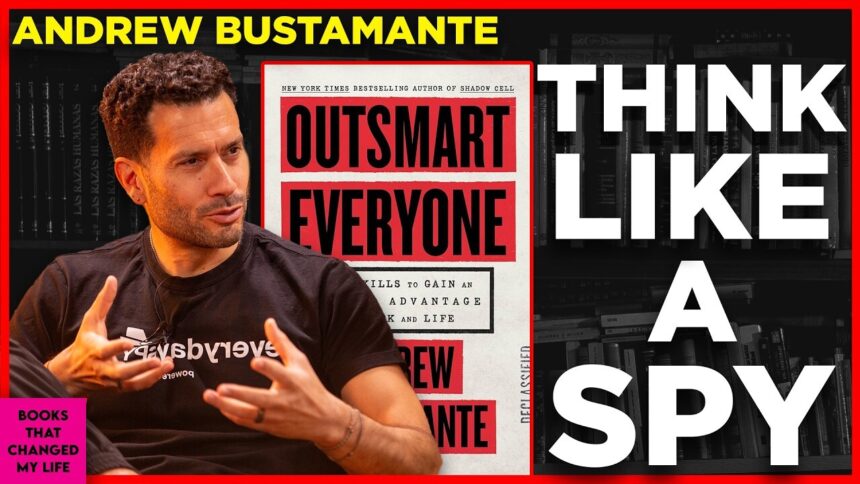
Andrew Bustamante, a former CIA intelligence officer and ex–US Air Force nuclear missile operator, reframes influence as a human-centered skill. His book, Outsmart Everyone, and his work with EverydaySpy translate covert tradecraft into techniques people can apply at work, in negotiations, and in relationships.
Core takeaway up front
Instead of winning by overpowering or deceiving, Bustamante teaches influence that conserves cognitive energy and creates mutual gain: identify what the other person already wants, remove the mental obstacles keeping them from that conclusion, and do so from a place of genuine vulnerability and aligned values.
About the guest and his approach
Andrew Bustamante blends CIA-derived observation and analysis with practical coaching for leaders and teams. He emphasizes human observation, strategic communication, and decision architecture rather than theatrical dominance. You can hear the full conversation on the Books That Changed My Life YouTube channel and on Spotify.
How people actually connect: vulnerability over armor
Bustamante uses a metaphor: when two people present only polished strength, they behave like “turtles trying to cuddle”—their protective shells prevent real contact. Genuine connection comes when people lower those defenses and meet at the private level.
- The three lives: public life, private life, and secret life. Much wasted energy goes into maintaining a public façade.
- Skin-to-skin connection: Relationships deepen when people share personal burdens and weaknesses rather than showcase competence alone.
- Leadership isolation: High performers and executives often experience loneliness; addressing that shared weight can open guarded leaders.
Outsmarting redefined: cognitive shortcuts and net-positive outcomes
Outsmarting isn’t about manipulation. It is about helping the brain take a simpler path to a decision it already prefers—so the outcome feels owned, not imposed. Bustamante contrasts manipulative tactics with a tradecraft built for mutual benefit.
Comparing approaches
Radical preference: craftsmanship over shortcuts
Bustamante’s idea of “radical preference” describes an obsessive fidelity to what you care about. In creative work or strategic systems, this means preferring effectiveness and conviction over sheer efficiency. The result is work that holds up over time because it reflects deep values, not just a checklist of tactics.
Quotation to remember: “We repel each other with our strengths and connect with each other through our vulnerabilities.” — Andrew Bustamante
Practical steps you can use
- Look for the three lives framework in conversations: which level is the person operating from?
- Lead with a small, genuine admission of weakness to invite reciprocal openness.
- Prioritize alignment: identify a shared burden or goal and address that before making requests.
- Apply radical preference: refine details that matter to the other person, not just what’s easiest for you.
Further listening and reading
- Sara Bareilles on The Interestings
- Margaret Cho on I’m With the Band
- Full episode: Spotify; archive: Books That Changed My Life.
Common questions answered
Q: Does outsmarting someone mean manipulating them for personal gain?
A: Not in Bustamante’s definition. The aim is to reduce mental work so the other person reaches a better decision on their own terms. That requires aligning outcomes, not tricking people into choices that later create resentment.
Q: Why do tradecraft tactics still work when both people know them?
A: Because these techniques rely on core psychological patterns and shared signals. When both parties recognize the effort to communicate clearly and honestly, they can move faster—mutual skill turns into mutual efficiency rather than manipulation.
Q: How do you build trust with high-level or guarded individuals?
A: Stop trying to match their public stance. Instead, acknowledge the common burdens of responsibility and isolation, offer a sincere short self-disclosure, and demonstrate that your goal is mutual relief or validation—not status competition.
Final reflection
Bustamante’s tradecraft reframes influence as empathy in motion: understand how people think, remove cognitive barriers, and use vulnerability to build durable trust. When practiced with craft and integrity, these techniques produce outcomes that feel owned by everyone involved.
If you want structured frameworks for leading with autonomy and intentional influence, consider the I AM LEADER Book Set for practical blueprints to defend autonomy and sharpen leadership performance.
Related reading on techharvey.com: Is Your Locus of Control Blocking Your Power of Choice?; Why Harry Hamlin Says This Book Gave Him True Inner Peace.